
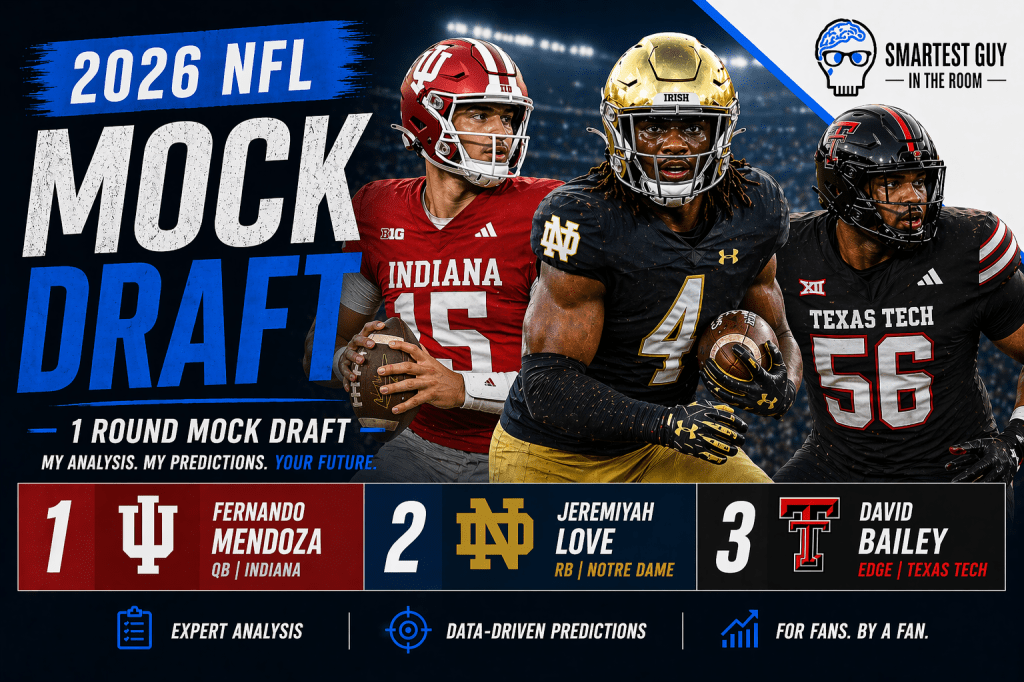
My complete first-round simulation for the 2026 NFL Draft, taking place in Pittsburgh.
1. Las Vegas Raiders – Fernando Mendoza, QB — Indiana
6’3″ | 216 lbs | Redshirt Junior
There is no debate here. Fernando Mendoza is the most complete college quarterback to enter the draft since Caleb Williams, and Las Vegas has earned the right to build around him. The Heisman Trophy winner and national champion out of Indiana brings a rare combination of pre-snap intelligence, ball placement, and pocket poise that translates immediately. His three-quarter release is lightning-quick, generating elite zip on intermediate throws, and his ability to read coverage rules before the snap — diagnosing shells, identifying leverage, and snapping into the right call — is genuinely next-level. He threw 41 touchdowns to just six interceptions and posted an absurd 27 red-zone TDs without a single pick inside the 20. The concern is mobility: Mendoza’s completion percentage dropped below 53% when flushed from structure, and he took virtually zero snaps under center at Indiana. The Raiders will need to build a wide-zone offense around him that keeps him comfortable in the pocket, but the foundation is franchise-altering.
2. New York Jets David Bailey, EDGE — Texas Tech
6’3⅝” | 251 lbs | Senior
The Jets were always going to come out of the top two with a pass rusher, and the debate between Bailey and Arvell Reese was the most polarizing conversation of the pre-draft process. New York goes with Bailey, and you can make a clean argument for it. The Texas Tech product led the FBS with 14.5 sacks and 19.5 tackles for loss in 2025, and his first-step quickness and spin move are already NFL-caliber. At 6’3⅝” and 251 pounds with nearly 34-inch arms, he has the length and power to anchor as a base 4-3 end or rush from a wide-nine alignment. Mel Kiper called him the class’s best speed-rusher; Bleacher Report’s scouting department grades him as a top-eight overall prospect. He’ll immediately pressure the quarterback from New York’s right side and give Aaron Glenn exactly the kind of engine he wants driving the pass rush. The floor is an elite specialist; the ceiling is a perennial Pro Bowler.
3.New Orleans Saints: Arvell Reese, LB/EDGE — Ohio State
▶Trade with the Arizona Cardinals
6’3″ | 245 lbs | Junior
Sliding to three is not a fall — this is a heist for Arizona. Arvell Reese is legitimately the top-ranked prospect on several major big boards, earning a 9.2-ish grade from multiple evaluators and claiming Big Ten Linebacker of the Year honors after posting 69 tackles, 6.5 sacks, and 10 TFLs for the national champion Buckeyes. What makes Reese special is his hybrid profile: he’s equally effective as an off-ball linebacker shredding run fits and as an edge rusher winning with pure explosion and power off the line. He’s the most versatile defensive player in the class. Daniel Jeremiah and others love him as a three-down chess piece — the kind of defender that forces offensive coordinators to account for him on every snap. New Orleans’ defense has needed an identity-setting player, and Reese provides exactly that, regardless of whether the Cardinals operate from a 4-3 or 3-4 base.
4. Tennessee Titans – Sonny Styles, LB — Ohio State
6’4″ | 240 lbs | Junior
Another elite Ohio State defender finds a home in the top four, and Sonny Styles is a perfect fit for what Tennessee wants to build defensively under Robert Saleh. Styles is a downhill-attacking linebacker with a rare size-speed combination — think Fred Warner meets Roquan Smith — who excels in coverage while still delivering pop against the run. His 6’4″ frame gives him the athleticism to match tight ends in man coverage and the physicality to anchor the second level against a run. PFF grades him as the most coverage-capable linebacker in the class. Multiple betting markets had Styles as a top-four favorite right up to draft night. Tennessee walks away with a player who gives their defense a true defensive identity piece for the next decade.
5. New York Giants – Jeremiyah Love, RB — Notre Dame
6’0″ | 212 lbs | Junior
New York is playing a different game with two first-round picks this year, and they’re using the fifth overall selection on arguably the highest-graded prospect in the entire draft, regardless of position. Bleacher Report’s scouting department ranks Jeremiyah Love as the No. 2 overall player in the class (9.0 grade). The Notre Dame Doak Walker Award winner is a dual-threat difference-maker who racked up back-to-back 1,000-yard seasons and 40 combined touchdowns over his junior season. Love’s 6.9-yard per carry average in 2025 speaks to the burst and explosion — but it’s his work as a receiver out of the backfield, his elite contact balance, and his ability to make defenders miss in the open field that elevate him to the transcendent tier. Bucky Brooks compared him to a “true RB1/WR2” that OCs covet as a featured weapon. Pairing him with Jaxson Dart at the skill level is exactly the kind of offensive building block John Harbaugh covets.
6. LA Rams – Jordyn Tyson, WR — Arizona State
▶ Trade with the Cleveland Browns
6’2″ | 205 lbs | Junior
Jordyn Tyson has WR1 upside that very few wideouts in recent memory can match. The Arizona State product’s superpower, as Kiper put it, is being open even when he appears completely covered. He wins on 50-50 balls, outmuscles defensive backs at the catch point, and is essentially unguardable in the red zone. The Colorado transfer lit up defenses for two straight seasons with the Sun Devils, posting elite separation numbers and showing an advanced ability to track the deep ball. PFF projects him as a potential Pro Bowl-and-All-Pro-caliber player if he refines his releases and maintains health. A hamstring issue cost him time last year, but teams are clearly not scared off. The Rams get insurance for Puka and Devante for the future, while also loading up for a SB run in 2026.
7. Washington Commanders Carnell Tate, WR — Ohio State
6’2¼” | 192 lbs | Junior
Washington continues to build the offensive infrastructure around Jayden Daniels, and Carnell Tate is arguably the safest receiver in the class. Jordan Reid ranks Tate as his WR1; Kiper calls him a precise route runner with great hands and outstanding body control. Ohio State’s next star in the receiver pipeline, Tate averaged 17.2 yards per catch last season and — crucially — caught 51 of 69 targets with only one drop. His gliding route-running style, featuring exaggerated moves and sharp head fakes, generates separation at every level of the route tree. Multiple evaluators drew comparisons to DeVonta Smith coming out of Alabama. Tate’s willingness to block only adds to his appeal. Washington gets a polished, immediate-impact receiver who can operate as a true WR1 opposite Terry McLaurin, giving Daniels a legitimate second weapon to attack defenses from multiple alignments.
8. Arizona Cardinals – Spencer Fano, OT — Utah
6’5″ | 305 lbs | Junior
▶ Trade with the New Orleans Saints
The Cardinals have been searching for franchise-level protection up front, and Spencer Fano is exactly that caliber of prospect. The Utah tackle earned a 92.0 PFF overall grade over the past two seasons — the top mark among all offensive tackles in this class — and brings a rare combination of loose hips, quick feet, and high-end athleticism that allows him to mirror speed rushers with ease. Bleacher Report grades him as the OT1 in the class. Fano lacks an ideal proportional build but compensates in every athletic dimension that matters at the next level: foot speed, hip fluidity, and lateral range to protect deeper drops. He can plug in immediately at the right tackle spot and represent an upgrade over any current option on Arizona’s roster.
9. Kansas City Chiefs- Rueben Bain Jr., EDGE — Miami
6’2½” | 268 lbs | Junior
Kansas City lands a premium edge rusher. Rueben Bain Jr. is the most disruptive interior/edge hybrid in the class — a bulldozing, high-motor defender who consistently wins with power and intelligence as both a run-stopper and pass rusher. Yes, the short arms (a historic third-percentile measurement) will be debated endlessly, but as PFF puts it, his production and play strength outweigh those concerns completely. Bleacher Report grades him as the No. 5 overall prospect. He had the class’s best power rush win rate and was the most dominant force on the Hurricanes’ defensive front. Andy Reid’s schematic creativity can maximize a player with Bain’s interior pressure profile, and Patrick Mahomes benefits immediately from an offense that doesn’t have to be perfect because opposing offenses will be under constant duress.
10. New York Giants Caleb Downs, S — Ohio State
5’11” | 198 lbs | Junior | Thorpe Award Winner
With Love already locked in at five, the Giants return to the board at ten and take the highest-graded prospect in this entire class, according to Bleacher Report (9.2). Caleb Downs is everything you want from a modern NFL safety — an instinctive, quick-diagnosing, coverage-capable centerpiece who functions as an extension of his defensive coordinator on the field. He diagnoses quickly, thanks to elite pre-snap instincts, is a reliable open-field tackler, and shuts down everything from slot receivers to tight ends in coverage at Ohio State. Kiper points out he adapted to Nick Saban’s system at Alabama as a freshman before transferring — that’s elite football IQ on display. Harbaugh’s defense needs a foundation piece in the secondary, and Downs is the kind of player who makes everyone around him better. The Giants come out of the first round with an elite playmaker at skill and the best safety prospect in years.
11. Miami Dolphins Francis Mauigoa, OT/IOL — Miami (FL)
6’5½” | 330 lbs | Junior | Consensus First-Team All-American
Miami keeps it local and gets one of the most physically impressive linemen in the draft. Francis Mauigoa was the No. 1 offensive tackle in the 2023 recruiting class, started all three years at right tackle for the Hurricanes, and earned consensus first-team All-American honors in 2025. His 1.1% pressure rate allowed is the third-lowest among all FBS tackles — that’s elite, tested pass protection at a major program. Mauigoa’s calling card is run blocking: he is a physical, dominant people-mover who uses his massive frame and impressive body strength to plow open run lanes consistently. The arm-length concern (33.25 inches) means his long-term home may be at guard, but the Dolphins can try him at right tackle first, where the combination of strength and technique makes him a plug-and-play starter. Either way, Miami gets a versatile, battle-tested anchor who immediately upgrades the protection around their quarterback.
12. Dallas Cowboys Mansoor Delane, CB — LSU
6’1″ | 192 lbs | Junior
Dallas lost significant secondary talent this offseason and landed an absolute steal in Mansoor Delane, who is the consensus CB1 in this class according to virtually every major evaluator. Bleacher Report grades him 8.2 — highest of any cornerback — and Bucky Brooks tabbed him the best in man coverage in the entire draft. Delane is a smart, physical press corner who can thrive in Cover 1 and 2 Man while using sharp backfield vision to bait quarterbacks in zone schemes. He’s capable of playing top-down, getting jumps on the QB, and making plays on the football. The Cowboys’ defense wants to play aggressive, man-principled, zone coverage — Delane is a tailor-made fit for that philosophy. Adding this caliber of cornerback to a secondary that was routinely exploited last season is exactly the kind of infrastructure play that turns a good defense into a great one.
13. Cleveland Browns Monroe Freeling, OT — Georgia
6’6″ | 305 lbs | Junior
▶Trade with the Los Angeles Rams
Monroe Freeling is a long, athletic prospect with a genuinely high ceiling. Despite fewer than 20 career starts at Georgia, Freeling showed marked improvement in the second half of the 2025 season that has evaluators excited about his development arc. He has the ideal size and length for the position, and his improved strength and cleaner hand usage make him a viable fit on the right side immediately. PFF notes he is a good mover, best suited for an inside zone-heavy scheme, which has been a staple of Todd Monken’s offenses. Freeling is the kind of developmental tackle you take, and he will be ready when Cleveland gets their franchise QB (likely in 2027).
14. Baltimore Ravens Olaivavega “Vega” Ioane, OG — Penn State
6’3½” | 328 lbs | Senior
Baltimore continues to invest in the offensive line that makes Lamar Jackson and Derrick Henry’s run game the most dominant in football, and Vega Ioane is arguably the best interior lineman in this class — or the entire draft, full stop. The Penn State guard is a legitimate people mover: he plays with excellent contact balance and technique on both base blocks and double teams, using his hips and hands for leverage and displacement in a way that physically dominates defensive tackles at the second level. NFL.com describes him as a “prototypical guard for physical run schemes with thick limbs, a broad frame, and plus core strength.” Pairing Ioane with the Baltimore system built around wide-zone and gap-running concepts is essentially putting a race car engine into a car already built for it. This is a franchise guard who will be dominant from day one.
15. Tampa Bay Buccaneers Malachi Lawrence, EDGE — UCF
6’4″ | 255 lbs | Senior
Tampa Bay gets one of the draft’s fast-risers at a clear position of need. Malachi Lawrence had a sensational NFL Scouting Combine showing that vaulted him into late first-round conversation, and several mocks have connected him to the Buccaneers specifically. He’s an athletic specimen with a relentless motor — a long-limbed edge rusher who won his way into a first-round grade through pure production and pass-rush traits. The Scouts Inc. grade puts him at 82/100. Lawrence gives Tampa Bay a spark plug off the edge who brings elite effort and a developing technical repertoire. The Buccaneers’ defense has the infrastructure to develop a high-motor pass rusher; Lawrence fits the bill as someone who projects as a starter with pass-rush upside that could blossom once he gains NFL coaching and refinement. For this range, the value is undeniable.
16. New York Jets Makai Lemon, WR — USC
5’10” | 185 lbs | Sophomore
New York gives their quarterback room, a slot weapon to complement Garrett Wilson. Makai Lemon is the premier slot receiver in this class — Kiper ranks him WR3 overall and the top slot player in the draft. He’s capable of more than just playing in the slot, though, and should get his fair share of snaps as a Z receiver as well. His ability to get in and out of breaks with alarming quickness, uncover quickly from press coverage, and generate yards after the catch makes him exactly the kind of chess piece that slot-heavy offenses weaponize every week. Analysts have compared his usage profile to Amon-Ra St. Brown, and after getting his Hutchison (Bailey) on defense, Glenn now has Wilson on the outside and Lemon in the slot — a formidable 1-2 punch in the passing game similar to the Lions’ Williams + Brown pairing. The Jets walked out of Round 1 building on both sides of the ball.
17. Detroit Lions Kadyn Proctor, OT — Alabama
6’7″ | 335 lbs | Junior
Detroit trades up to secure the left tackle of the future before the offensive line run gets out of hand. Kadyn Proctor is a mass of humanity — extraordinary size and length with the rare ability to function as both a move blocker and a dominant downhill people mover. NFL.com describes him as a “roadblock to speed-to-power charges” with a stout anchor and strong hands when set and centered. Inconsistency in pass protection has kept his stock variable (draft range from pick 6 to pick 23 depending on the evaluator), but Dan Campbell’s Lions are the ideal development environment for a physically gifted tackle who benefits from coaching and reps. Proctor slots in on the left side and gives Detroit a mauling blindside protector for the next decade. The Lions add another brick to arguably the NFL’s most physically dominant offensive line culture.
18. Minnesota Vikings Dillon Thieneman, S — Oregon
6’1″ | 200 lbs | Junior
The connection between Dillon Thieneman and Minnesota has been one of the draft’s most persistent storylines, and for good reason. Multiple mock drafts across the industry pegged this pairing as a natural fit, and Bleacher Report grades Thieneman as a top-20 prospect. He is an instinctive, rangy safety who plays as an extension of his defensive coordinator — aligning the secondary to motion, reading pre-snap shifts, and making his best plays in zone by anticipating route concepts. NFL.com calls him a “savvy three-year starter with alignment versatility” who can roll down into big nickel or robber positioning with ease. He’s not a big-play hitter, but his pursuit tackling and coverage instincts are outstanding. For Minnesota, who need to find Harrison Smith’s long-term successor, Thieneman checks every box the organization has historically valued in the deep safety position.
19. Philadelphia Eagles – Max Iheanachor, OT — Arizona State
6’6″ | 312 lbs | Junior
▶Trade with the Carolina Panthers
Philadelphia invests in the offensive line and takes a talented, upside-driven tackle who brings an enticing developmental profile. Iheanachor was the top-rated offensive tackle in the Sun Devils’ program and gives the Eagles a long-limbed, athletic blocker to take over for Lane Johnson, with a frame that projects to continue filling out at the next level. PFF tags him as a player brimming with upside, and Scouts Inc. grades him at 84. He can provide depth immediately and compete for a starting role as he develops. His raw traits — length, athleticism, and a solid first step — give the Eagles coaching staff plenty to work with over the next few seasons.
20. Dallas Cowboys Keldric Faulk, EDGE/DL — Auburn
6’3½” | 285 lbs | Junior
Dallas doubles down on defense — this time adding a physically imposing defensive lineman who doesn’t turn 21 until September. Keldric Faulk is a monster against the run and a blank slate as a pass rusher, and that combination is genuinely intriguing at this range. Auburn’s scheme limited his pure pass-rush opportunities, but he’s the class’s most versatile interior/edge player, capable of playing defensive end in multiple fronts or sliding inside in sub packages. Multiple mock drafts had him going in the top 15 range; Kiper grades him 26th overall. The Giants’ own analysis praised him as having “run defending tape” among the best in the class. After selecting Delane in the first half of Round 1, the Cowboys now have a cornerstone cornerback and a dynamic young defensive lineman alongside Quinnen Williams. Dallas’ defense enters 2026 with a dramatically different identity than a year ago.
21. Pittsburgh Steelers Omar Cooper Jr., WR — Indiana
5’11” | 195 lbs | Junior
Pittsburgh gets an immediate offensive weapon and hands Aaron Rodgers a proven college performer with outstanding inside/outside versatility. Omar Cooper was the co-WR1 on Indiana’s national championship team, catching 69 passes for 937 yards and 13 touchdowns in the regular season alongside Fernando Mendoza. He is an instinctive route runner who thrives in space and can operate from multiple alignments — out wide or in the slot — giving offensive coordinators real schematic flexibility. Bleacher Report grades him as a top-25 overall prospect (8.0). Cooper pairs well alongside Michael Pittman and DK Metcalf, and gives Pittsburgh a three-receiver set with different skill profiles that can stress zones horizontally. His polished college production and experience in a run-first, efficiency-driven program mean he’s ready to contribute on day one without a steep learning curve.
22. Los Angeles Chargers Akheem Mesidor, EDGE — Miami
6’3″ | 270 lbs | Super Senior
Los Angeles has been flagging aging edge contracts and takes the second Miami Hurricane pass rusher off the board in what was a remarkably productive defensive end room in Coral Gables. Mesidor is the power complement to Bain’s explosiveness — a technically refined rusher who uses his plus length and play strength to win with bull rushes and swim moves. He’s older (already 25 after six years of college football), but Kiper grades him as the fifth-best edge rusher in the class, and PFF projects him as a top-50 pick with an impact role as a 3-4 outside linebacker. The Chargers need edge help with Khalil Mack’s future uncertain, and Mesidor can step in and contribute immediately opposite whoever they deploy on the left side. Jim Harbaugh’s aggressive defensive scheme suits a disruptive interior/edge hybrid who won’t need much acclimation time.
23. Carolina Panthers – Kenyon Sadiq, TE — Oregon
6’5″ | 252 lbs | Junior
▶ Trade with the Philadelphia Eagles
Carolina adds a premium tight end and gives Bryce Young another weapon in the red zone and down the seam. Kenyon Sadiq is the clear TE1 in this class — Scouts Inc. grades him at 89, Bleacher Report at 8.0, and Bucky Brooks calls him the consensus top tight end in the draft. He is an advanced pass catcher with the size to occupy linebacker attention and the athleticism to separate against nickel defensive backs. His ability to flex out and run route trees from the slot while also serving as a legitimate in-line blocker makes him a true every-down tight end at the next level.
24. Cleveland Browns, KC Concepcion, WR — Texas A&M
5’9″ | 175 lbs | Junior
Cleveland adds a dynamic slot weapon who can immediately change the pace of their offense. KC Concepcion is one of the most elusive receivers in this class, offering immediate burst and separation on every snap. NFL.com’s evaluator describes him as able to “snap off routes with alarming suddenness,” making him extremely difficult to match at leveraged break points. He’s an explosive complement to Harold Fanin and Jerry Jeudy in the Browns offense.
25. Chicago Bears Peter Woods, DT — Clemson
6’4″ | 295 lbs | Junior
Peter Woods never quite lived up to the hype of being the No. 1 DT recruit in the 2023 class at Clemson, but he’s still only 21 years old and carries the kind of physical upside that front offices fall for in this range. He posted just 5 sacks and 14.5 tackles for loss in college, but his athletic profile — first-step quickness, power, and natural penetration skills — gives Chicago something to develop behind their current defensive line. Kiper grades him 32nd overall, and multiple major boards have him as a late first-round value. The Bears have been in the market for interior defensive line help, and Woods represents an ideal developmental bet: you’re wagering that NFL coaching and consistent reps will unlock the potential of a player whose physical ceiling was clearly evident to teams during the evaluation process. If it clicks, Chicago has a cornerstone defensive tackle on a rookie deal.
26. Kansas City Chiefs Caleb Lomu, OT — Utah
6’6″ | 310 lbs | Junior
▶ Trade with Buffalo Bills
Buffalo addresses offensive line depth and long-term infrastructure with one of the more athletically gifted tackles in this class. Caleb Lomu’s calling card is elite agility and quickness — Kiper notes he allowed just three sacks over 1,500-plus career snaps at left tackle, which is an elite figure for any tackle prospect regardless of conference. He deals with speed rushers particularly well, thanks to his athletic profile, gets to the second level as a run blocker, and keeps his feet through contact. The concern is strength: Lomu needs to add weight and functional power to his frame to handle NFL bull rushers consistently. But at this range, that’s a workable developmental concern rather than a disqualifier. Kansas City has not forgotten the number the Eagles put on them in the Super Bowl a couple of years back. Adding Lomu to last year’s selection of Simmons ensures that Mahomes never has to go through that again, once both players fully develop.
27. San Francisco 49ers Kayden McDonald, DT — Ohio State
6’3″ | 291 lbs | Junior
San Francisco has needed help in the interior after their defensive line depth was hit by injuries, and Kayden McDonald is a highly regarded DT who brings nose tackle versatility with penetrating ability. Bleacher Report grades him 7.9 overall, and Scouts Inc. slots him at 87 — late first-round value for a player multiple major boards had as the best run-stopping defensive tackle in the class. His 4.79-second 40-yard dash at the combine turned heads for a 291-pound interior lineman, and his natural leverage and burst allow him to occupy multiple blockers while still generating interior pressure. The 49ers’ wide front defense benefits enormously from a penetrating 3-technique who can pair with Nick Bosa off the edge to create two-way pressure. McDonald gives Kyle Shanahan’s defense a versatile, big-bodied presence along the interior.
28. Houston Texans Blake Miller, OT — Clemson
6’7″ | 317 lbs | Junior
Houston uses their ick to invest in CJ Stroud’s long-term protection, and Blake Miller checks nearly every box you want from a right tackle prospect. At 6’7″ and 317 pounds with 34-inch arms, he has elite NFL size for the position and started 54 career games at Clemson — experience that matters. PFF notes “no medical flags” on his evaluation, and his elite athletic profile (superior mobility for his size) makes him a clean fit at right tackle. Multiple evaluators had him in the top 27 range. Houston’s offensive line has needed an infusion of quality tackle play, and Miller can slide in and start at right tackle immediately. He’s a prototypical developmental right tackle with the ceiling of an excellent starter in an offense built around protecting the pocket for a franchise quarterback.
29. Buffalo Bills – CJ Allen, LB — Georgia
6’1½” | 240 lbs | Junior
▶Trade with the Kansas City Chiefs.
CJ Allen is a downhill, hard-nosed linebacker with the scheme versatility to play in new DC Jim Leonhard’s defense, which has historically used linebackers as key fulcrums in coverage and as blitz threats. Kiper grades him 28th overall. Allen’s defining trait is his relentless pursuit and downhill trigger — he fires into gaps and beats running backs to the spot with impressive consistency. His coverage skills in zones are developing, but his instincts as a run defender are NFL-ready.
30. Miami Dolphins- Chris Johnson, CB — San Diego State
6’0″ | 192 lbs | Senior
Miami doubles back in the round and invests in its secondary. Chris Johnson is a quietly excellent prospect who has worked his way onto multiple team boards inside the top 100. After Delane, most evaluators view Johnson as the second cornerback off the board, and Scouts Inc. grades him at 85. His film from SDSU against bigger-school competition is spectacular — physical, competitive, and capable of matching vertically against NFL-caliber route runners. Multiple NFL scouts have praised the cleanliness of his evaluation: no major medical flags, no character concerns, and high-quality tape that jumps off the screen. The Dolphins need secondary help after a difficult 2025, and Jeff Hafley’s defense benefits from an intelligent, film-savvy corner who can operate in both man and zone coverage. Johnson gives Miami a potential starter and a cornerback tandem to build around entering next season.
31. Arizona Cardinals – Ty Simpson, QB — Alabama
6’2½” | 222 lbs | Junior
▶Trade with the New England Patriots.
Cardinals trade up, both to beat the Jets, and lock in that 5th year on a rookie deal. Ty Simpson is the consensus QB2 in this class, and while the class isn’t deep at the position, he represents legitimate starting potential. The Alabama quarterback has rhythmic, well-timed dropbacks, excels at working quick and intermediate passing plays, and uses effective eye manipulation to create throwing windows. Scouts Inc. grades him 85. His progression from first to last read is a genuine strength, and his cadence and pocket fluidity project better in a pro-style offense than most analysts give him credit for. The concern is only 15 career starts and a drop in production in the back half of 2025 — but landing in a thoughtful developmental environment in New England could allow Simpson to develop at his own pace before being asked to carry a full offense.
32. Seattle Seahawks, Treydan Stukes, CB/S — Arizona
6’0″ | 190 lbs | Senior
Seattle closes out Round 1 in perfect Mike Macdonald fashion: a versatile, high-character defensive back with the athleticism to wear multiple hats in a complex secondary. Treydan Stukes has been called the “Most Versatile” cornerback in the class by Bleacher Report (7.4 grade), and Kiper grades him 71st overall — a value selection at 32. His 4.33-second speed on a 6-0, 190-pound frame with 32-inch arms gives Seattle the kind of length-speed combo they lost when Riq Woolen’s contract situation became complicated. He can play outside corner, nickel, or safety, giving Macdonald extraordinary flexibility in his defensive constructions. Multiple Seahawks-specific mock drafts cited Stukes as a natural character fit alongside a defense that emphasizes intelligence and versatility above all. Seattle ends Round 1 with a player who could legitimately impact three different roster spots depending on how the depth chart shakes out in camp.
 The Smartest Guy in the Room